
Current Projects
Our current projects reflect a unified effort to understand and address sociobehavioral comorbidities in surgery. Using mixed methods, causal inference, and decision modeling, we examine how social and behavioral risks shape complications, recovery, costs, and long-term outcomes.
A central resource for this work is the SASSY Lab’s prospectively maintained database of preoperative sociobehavioral assessments, the largest known dataset of its kind. This unique infrastructure enables us to rigorously examine how sociobehavioral risk factors influence surgical outcomes and to develop evidence-based strategies to mitigate those risks.
Across studies, our work spans rigorous measurement, predictive modeling, and the design and testing of targeted perioperative interventions. Together, these projects build the evidence needed to integrate sociobehavioral risk into the standard science and practice of surgical care.
-
How should sociobehavioral comorbidities be measured in surgery?
We develop and evaluate approaches to measuring sociobehavioral risk at the patient level. Our work explores how comprehensive patient-reported assessments, clinical screening practices, and neighborhood-level indicators can be used to identify meaningful risk in surgical populations.
Current areas of inquiry include:
Developing and psychometrically evaluating comprehensive surveys of sociobehavioral comorbidities in surgical patients
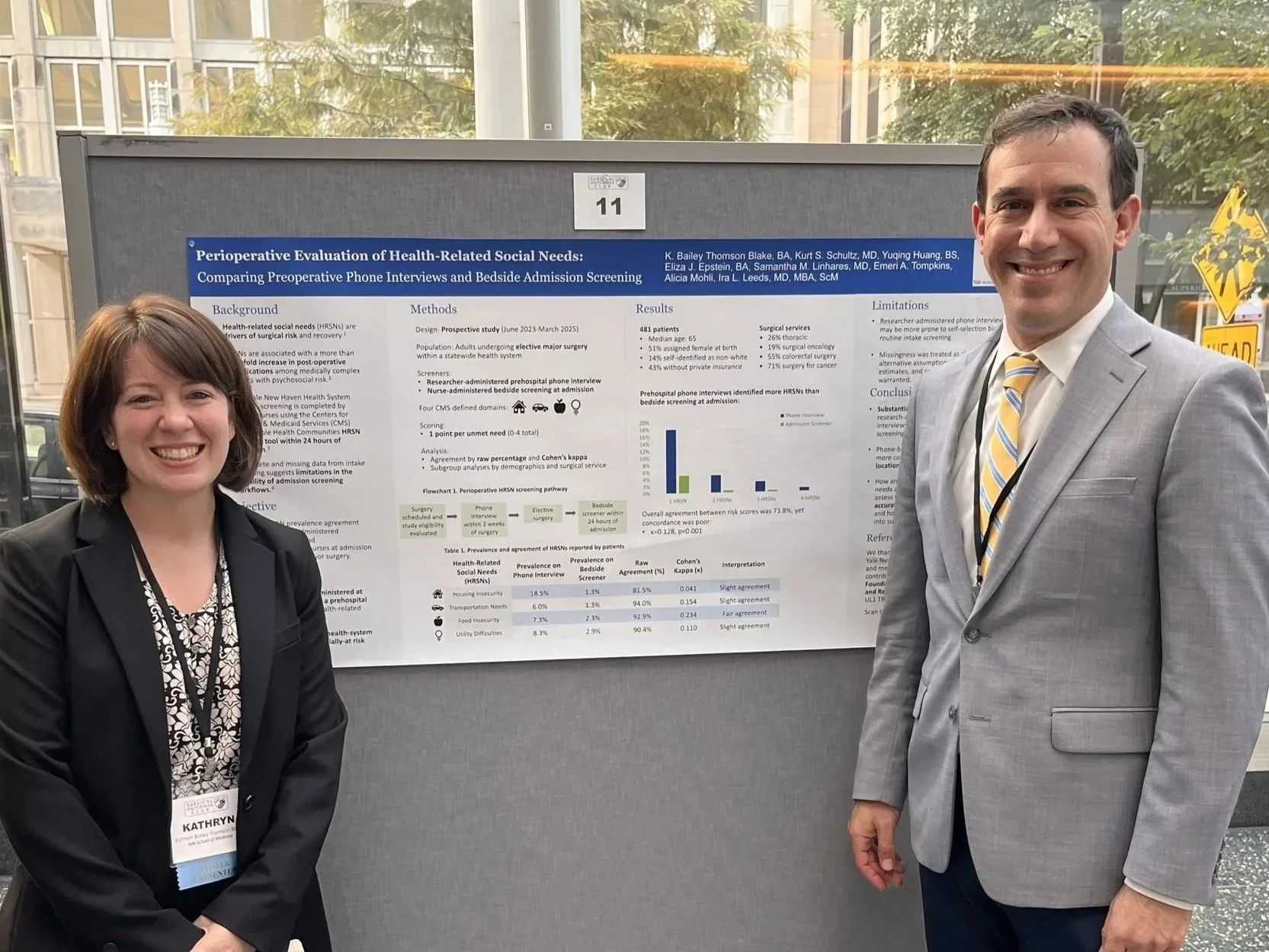
Examining the implementation of bedside health-related social needs (HRSN) screening and how clinicians operationalize these assessments in practice
Exploring computational approaches, including large language models, to detect sociobehavioral risk from clinical data
Using spatial analysis to study how neighborhood-level indices relate to patient-level sociobehavioral vulnerability
-
Which sociobehavioral comorbidities meaningfully predict surgical outcomes?
We use patient-level datasets and large national surgical registries to identify which social and behavioral risks are independently associated with complications, recovery trajectories, and healthcare utilization. By integrating detailed sociobehavioral assessments with clinical and administrative data, our work seeks to improve how surgical risk is predicted and understood.
Current areas of inquiry include:
Quantifying how sociobehavioral comorbidities influence postoperative complications and recovery
Examining how social and behavioral risk contributes to delays in surgical treatment and care pathways
Investigating prolonged hospital stays that occur in the absence of clinical complications
Leveraging large integrated healthcare system cohorts to study sociobehavioral risk and surgical outcomes at scale
-
What should we do when a sociobehavioral comorbidity is identified?
Our work seeks to translate measurement and prediction into action. We design and evaluate strategies to mitigate modifiable sociobehavioral risk in the perioperative period, with the goal of improving recovery, reducing complications, and making surgical care more responsive to patients’ real-world needs.
Current areas of inquiry include:
Behavioral health–informed strategies to support patients facing psychosocial vulnerability around the time of surgery
The potential role of non-clinical support personnel in helping patients navigate the perioperative period
The use of targeted resource supports and in-kind transfers to address specific barriers to recovery
Cost-effectiveness analyses to determine which perioperative interventions generate meaningful improvements in outcomes and value
-
How are sociobehavioral comorbidities experienced and navigated by patients undergoing surgery?
Through qualitative and mixed-methods research, we examine how patients experience sociobehavioral vulnerability in the perioperative period. These studies aim to illuminate the pathways through which social and behavioral factors shape surgical care and recovery, and to inform the development of more patient-centered interventions.
Current areas of inquiry include:
Qualitative studies exploring how sociobehavioral comorbidities are experienced by patients preparing for and recovering from major surgery
Developing conceptual frameworks that explain how sociobehavioral risk operates within surgical care pathways
Examining patient experiences within large integrated healthcare systems to better understand structural barriers to recovery